
Commercial
Business clearance
Offices, units, shops and yards — cleared around the trading day or outside it, with paperwork that satisfies the landlord and the auditor both.
Commercial clearance is a different job from domestic, and mostly for reasons that have nothing to do with the contents. It is the same desks and racking either way. What differs is that there is a lease, a landlord, a date, and somebody who will be held responsible if the paperwork is wrong.
What comes out
- Desks, chairs, pedestals, meeting tables, partitioning
- Racking, shelving, pallet racking, mezzanine steel
- IT: monitors, towers, printers, servers, network kit, cable
- Catering and washroom equipment, air conditioning units, extraction
- Shopfittings, display units, counters, signage
- Yard scrap, skips of offcuts, old plant
Racking and mezzanine steel in particular is worth real money as heavy scrap, and that comes off the cost of the clearance rather than disappearing into it.
Around the trading day, or outside it
A shop cannot lose a Saturday and an office cannot have a stairwell blocked at eleven on a Tuesday. Evenings, weekends and early starts are normal for this kind of work rather than a special favour, and it is usually cheaper overall than the disruption of doing it in hours.
If the building has a goods lift, a loading bay booking system, or a facilities manager who needs notice, tell us at the quoting stage. Those are the things that turn a half-day into a full one.
Lease ends and dilapidations
If this is a lease end, the clearance is usually one item on a schedule of dilapidations, and the standard being measured against is the lease rather than common sense. Get us the schedule if you have it. “Clear to bare shell” and “leave in tenantable repair” are different jobs and it is much cheaper to know which one you are buying before we start.
IT and data
We will take the hardware. What we will not do is tell you it has been data-wiped, because that is a certified process and it should come from somebody who certifies it.
The straightforward version: pull the drives before it goes, or have them wiped by whoever does your IT, and then the machines are just metal, plastic and boards. If you need certificates of destruction for the drives themselves, say so and we will point you at somebody who issues them properly rather than pretend that is us.
Paperwork
A waste transfer note for every load. Businesses have a duty of care over their waste that is stricter than a householder’s, and it does not end when the van pulls away — it ends when you can show where it went. We invoice, so it goes through the books cleanly, and we are happy to be added as an approved supplier if your procurement wants that.
On the job
What this actually looks like
How it works
Three steps. No site visit.
Send a photo
WhatsApp a picture of whatever needs shifting. No need to tidy it first or guess the weight.
Get a price
A straight number back, usually the same day. The real price for your actual load.
It’s gone
We turn up, load it, sweep up, and you get the paperwork showing where it went.
The money bit
What actually decides the price
Nobody likes “it depends”. Here is what it actually depends on, so you can guess pretty well before you even send the photo.
01
How much there is
The biggest single factor, and the one the photo answers on its own. We price by what it takes to shift — part of a van, a full van, one tipper load, three.
02
What’s in it
Some things carry a disposal charge by law — fridges, mattresses, tyres, plasterboard, paint. Others go the other way: if there’s real metal in the load, that value comes off your price.
03
How hard it is to reach
Kerbside and a wide drive is quick. Up two flights, through a narrow side gate, or forty yards down a wet garden is not. We’re charging for the time, not punishing you for the stairs.
04
Where you are
Wymondham and Hethersett are on the doorstep. Beccles is a run. It’s rarely the deciding factor, but it’s honest to say it counts for something.
Why there’s no “from £80” on this page
Because a from-price is a number chosen to get you on the phone, not a number anyone intends to charge. You ring, it turns out your job isn’t the one job in a hundred that qualifies, and the real figure lands once someone is already stood on your drive.
We’d rather you got the actual number for your actual load, in writing, before anyone turns up — and that you were free to ignore it. The price we send is the price you pay, unless you add to the pile, in which case tell us and we’ll re-quote.
Skip or us
A skip is a box you fill yourself.
Sometimes a skip genuinely is the right answer — a long refurb, a job where waste appears over weeks. For a one-off clear-out, it’s usually the more expensive way to do your own lifting.
| What | A skip | Us |
|---|---|---|
| Who loads it | You do, over several evenings | We do, while you make a cup of tea |
| Permit | Needed if it stands on the road, from the council | Never — nothing is left anywhere |
| How long it’s there | Sat on your drive for the hire period | Gone the same visit |
| How full | Level with the rim, no higher | Loaded properly, stacked, strapped |
| Fridges & mattresses | Usually excluded or surcharged | Taken, and handled under the WEEE rules |
| Sorting | Whatever went in goes as mixed waste | Metal pulled out and recycled, rest sorted |
| Paperwork | A hire invoice | A waste transfer note with our carrier number on it |
One thing worth knowing either way: your duty of care follows the waste, not the container. Hiring a skip from an unregistered operator lands you in exactly the same place as handing it to a van — here’s how to check either of them.
More waste clearance
House clearance
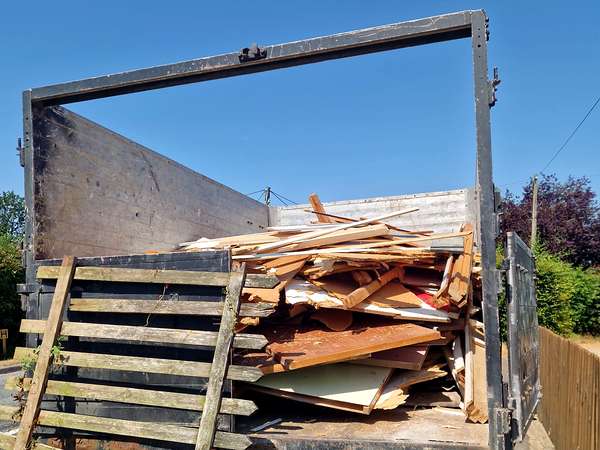
A full house or a single room. We load it, sweep up, and leave it ready for the agent.
See more →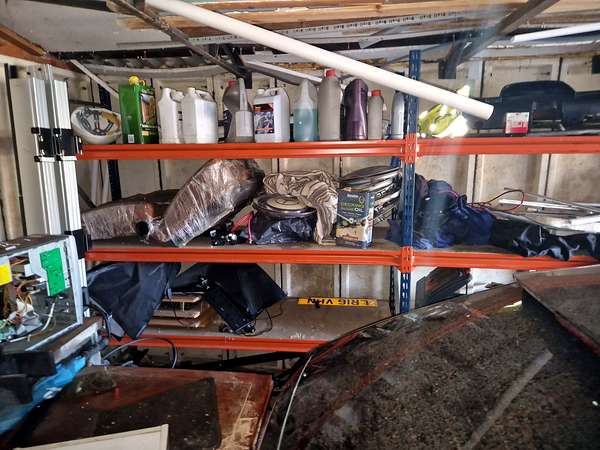
Garage clearance
Thirty years of paint tins, offcuts and things that might come in handy one day.
See more →Probate clearance
Unhurried, documented, and used to working alongside the firm handling the estate.
See more →FAQ
Straight answers
Can you work outside trading hours?
Yes. Evenings, weekends and early starts are normal for commercial work rather than a favour, and it usually costs less overall than losing a trading day.
Do you take IT equipment?
We take the hardware. We will not tell you it has been data-wiped, because that is a certified process and the certificate should come from whoever does it. Pull the drives or have them wiped first, and the rest is metal, plastic and boards.
Do you invoice, or is it payment on the day?
We invoice. We are used to going through procurement and being added as an approved supplier, and every load comes with a transfer note for your duty-of-care file.
What areas do you cover?
Wymondham and everywhere down the A11 and A47 — Norwich, Attleborough, Thetford, Diss, Long Stratton and across into Suffolk to Beccles and Bungay. If you are not sure, just ask.
Is it all done legally?
Yes. We are an upper-tier registered waste carrier and a licensed scrap metal dealer with both councils, and every load comes with a waste transfer note. Ask for our registration number when you ring and we will give it to you, so you can check it against our name on the public register.
How quickly can you come?
Often the same week, sometimes the same day if we are passing. Tell us where you are and you will get the honest answer rather than the one that gets us the booking.